Fourteen years. That is all the Bauhaus got before the Nazis shut it down, and it was enough to change how the modern world looks.
This TASCHEN introduction tells the story of the Bauhaus art school, which stands as one of the defining movements of modern history. It covers the school's commitment to creative expression, cutting-edge ideas, and the combination of fine art and technology in service of a utopian future.
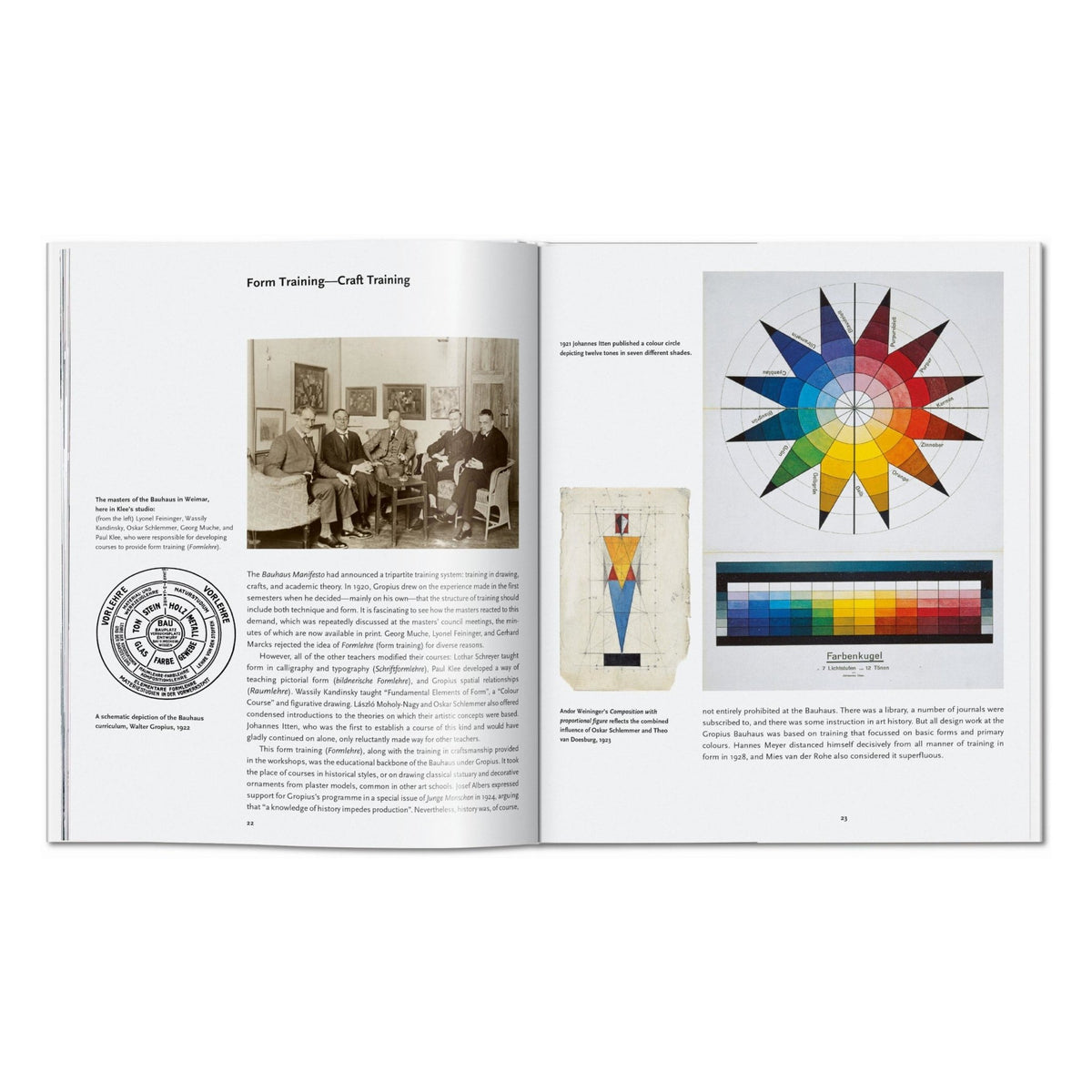
That combination is the whole point. The Bauhaus refused to keep painting, craft, architecture, and industry in separate rooms. Students learned from artists and craftspeople side by side, worked with materials directly, and were pushed toward objects that could be made well and made for many. The results still surround us: tubular steel chairs, clean lamps and metalwork, flat roofs and glass walls, color theory taught as a discipline, and typography stripped back to what it needs to do.
The school's history is short and turbulent. It moved more than once and worked under constant political pressure before it was closed. Its people scattered across Europe and the United States, and its ideas traveled with them into architecture offices, design schools, and factories, which is part of why the influence feels so universal now.
For anyone who works in design, the Bauhaus is less a style than a set of questions. What is this object for? What is the honest way to make it? How do art and technology work together instead of against each other? Those questions are as useful in a branding studio or an edit suite as they were in a workshop.
In Signals, Bauhaus is foundational reading: the source code behind a huge share of modern design.
About the Bauhaus
The Bauhaus, officially the Staatliches Bauhaus (German for building house), was an art school founded by the architect Walter Gropius in Weimar on April 1, 1919. It set out to bring fine art and craft together, and increasingly to unite artistic vision with function and mass production, in pursuit of a total work of art.
The school had three homes and three architect-directors. It ran in Weimar from 1919 to 1925 under Gropius, then moved to Dessau, where the landmark Bauhaus building he designed opened in 1926. Hannes Meyer led the school from 1928 to 1930 and Ludwig Mies van der Rohe from 1930. After the Nazi party took over the regional government, the Dessau campus closed in 1932; Mies reopened it in a derelict factory in Berlin, and it closed for good in 1933 under pressure from the Nazi regime. Teachers included Johannes Itten, who taught the preliminary course, Lyonel Feininger, Oskar Schlemmer, Paul Klee, Wassily Kandinsky, László Moholy-Nagy and the weaver Gunta Stölzl. Landmarks include the Haus am Horn (1923), the Dessau building (1926) and Marcel Breuer's B3 chair (1925–1926), later known as the Wassily chair.
Its people carried the ideas abroad: Gropius taught at Harvard's Graduate School of Design and Mies led the architecture school at Chicago's Armour Institute. Bauhaus sites in Germany joined the UNESCO World Heritage List in 1996, and Tel Aviv's White City holds the world's highest concentration of Bauhaus architecture. Graphic design, typography, furniture and architecture still run on Bauhaus thinking.
Why Bauhaus still matters
Bauhaus still matters because it set the template for how art, design, and technology can work together. Its ideas about form, function, materials, and education shaped architecture, furniture, graphic design, and design teaching worldwide. When people say something looks modern, they are very often describing the Bauhaus.
Who this book is for
For designers, architects, art directors, typographers, and design students. For the RIOT and vandal_ crowd who want to understand where modern visual language came from, and for anyone looking for a clear, illustrated introduction to the school and its ideas.
Product details
-
Title: Bauhaus
-
Subject: The Bauhaus art school
-
Publisher: TASCHEN
-
Language: English
-
Focus: The school's commitment to creative expression, cutting-edge ideas, and the combination of fine art and technology
-
Category: Architecture and design, print book
FAQ
What is this Bauhaus book about?
It introduces the Bauhaus art school, its commitment to creative expression and cutting-edge ideas, and its combination of fine art and technology.
Is it a good introduction for beginners?
Yes. TASCHEN presents it as an introduction to the school, so it works as an accessible starting point.
How long did the Bauhaus exist?
Just fourteen years, before it was shut down by the Nazis.