


Keith Haring Book — Street Art, Pop Art & 1980s New York
Keith Haring Book — Street Art, Pop Art & 1980s New York
Couldn't load pickup availability
Keith Haring made art that moved fast, hit hard, and belonged to everybody.
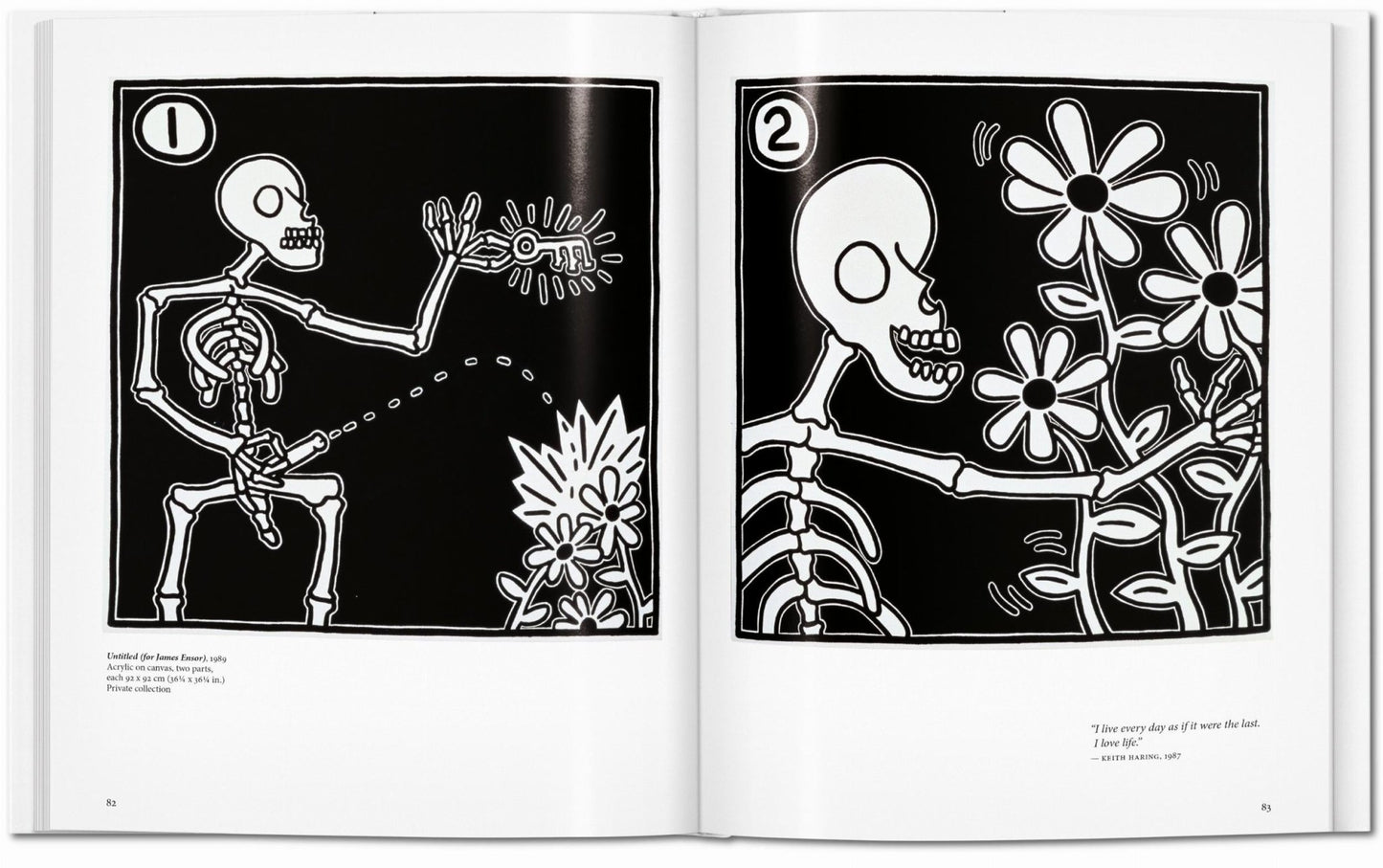
This TASCHEN volume is a concise introduction to one of the defining artists of the 1980s — a figure who fused street art, graffiti, Pop Art, and cartoon-like imagery into a visual language that became instantly recognizable around the world. With thick black outlines, radiant movement, bright colors, and symbols that seemed to pulse with urgency, Haring built a body of work that could live on subway walls, gallery walls, posters, products, and in the wider visual bloodstream of popular culture.
What made Keith Haring different was not only style, but access. His work felt open. Immediate. Legible. He took the language of the street and turned it into a global iconography without draining it of energy. From his early chalk drawings in New York City subway stations to the now-legendary Radiant Baby, Haring created images that felt playful on the surface but often carried real political and social charge underneath.
That tension is part of what still makes his work feel alive. Beneath the bright colors and dancing figures, Haring confronted racism, capitalism, religious fundamentalism, homophobia, and the escalating impact of AIDS on New York’s gay community. His art did not retreat from public life. It ran straight into it. This book captures that combination of visual joy and social commitment, showing how Haring’s work could be both accessible and confrontational at the same time.
The story here is also deeply tied to 1980s New York — a city moving at full speed, where downtown culture, club life, activism, design, advertising, fashion, and art were constantly colliding. Haring emerged from that world as one of its clearest voices. From subway interventions to the Pop Shop in SoHo, from public murals to commercial collaborations like Swatch and Absolut Vodka, he refused the old boundaries between high art, street culture, and mass communication.
 For artists, designers, illustrators, filmmakers, students, collectors, and anyone interested in Keith Haring, Pop Art, street art, or the visual culture of downtown New York, this is an easy recommendation. It works as both an accessible entry point and a compact reference object — the kind of book that reminds you that clarity, repetition, symbol, and conviction can still cut through noise.
In Signals, we see books like this as more than books. They are visual voltage. Cultural language in motion. Proof that immediacy can still carry depth.
Why Keith Haring still matters
Keith Haring still matters because he created a public visual language that was instantly readable yet politically charged. His art bridged street art, Pop Art, activism, and design in a way that changed how contemporary culture thinks about image-making in public space. His symbols became part of global visual culture, but their force came from something deeper: the belief that art should be direct, social, and available to everyone.
Who this book is for
For artists, designers, illustrators, filmmakers, students, collectors, and anyone interested in Keith Haring, street art, Pop Art, activism, and 1980s New York visual culture.
Product details
- Title: Haring
- Artist: Keith Haring
- Publisher: TASCHEN
- Series: Basic Art Series
- Author: Alexandra Kolossa
- Language: English
- Format: Hardcover
- Trim Size: 8.3 x 10.2 in.
- Weight: 1.37 lb
- Pages: 96
- ISBN: 978-3-8365-3049-1
FAQ
What is this Keith Haring book about?
This book introduces Keith Haring’s life, work, and influence, covering his subway drawings, Pop-inflected visual style, activism, public art, and role in the 1980s New York art scene.
Is this a good Keith Haring book for beginners?
Yes. It works well as a concise but meaningful introduction to Haring’s art, symbols, and cultural impact.
Does the book cover Haring’s activism?
Yes. A major part of Haring’s significance comes from the way his work addressed social and political issues including AIDS, racism, capitalism, and religious fundamentalism.
What format is this edition?
This edition is a hardcover English-language book with 96 pages.



What is vandal_?
A creative marketplace for the misfit class. We curate tools, gear, assets, fonts, streetwear and digital weapons for people rewriting the rules. No fluff. No permission. All signal.
What kind of stuff do you sell?
Display fonts. Glitch textures. Gradient payloads. Tools that hit. Hoodies, Zines, essays, assets, shirts that don’t ask. Everything is made by or curated by creators who choose to live outside the algorithm.
Is vandal_ royalty-free?
Yup. Buy it once. Use it in your work—client or personal. Don’t resell it or pretend you made it. That's the only rule.
How can I join the marketplace?
If you make dope, useful, weird, disruptive creative stuff—we want to see it. Drop us a line. We’re building this together.
Why does vandal_ feel different?
Because it is. This isn’t just commerce—it’s community, rebellion, and real creativity, all wrapped in downloadable, readable and wearable form.
-

Our Disposable World
A structural argument for commitment, accountability, and designing work that refuses to disappear.
Our Disposable World
A structural argument for commitment, accountability, and designing work that refuses to disappear.
-

Marking Space
A look at marking space, authorship, permanence, and why vandalism has always been about presence—not destruction.
Marking Space
A look at marking space, authorship, permanence, and why vandalism has always been about presence—not destruction.

