Eadweard Muybridge froze motion so the world could finally see it.
This TASCHEN volume covers the life and work of Muybridge (1830–1904), the pioneer in the visual studies of animal and human movement. With a detailed chronology and many plates, it features in particular many images from his groundbreaking Animal Locomotion, as well as from his handmade and extremely rare first album, The Attitudes of Animals in Motion.
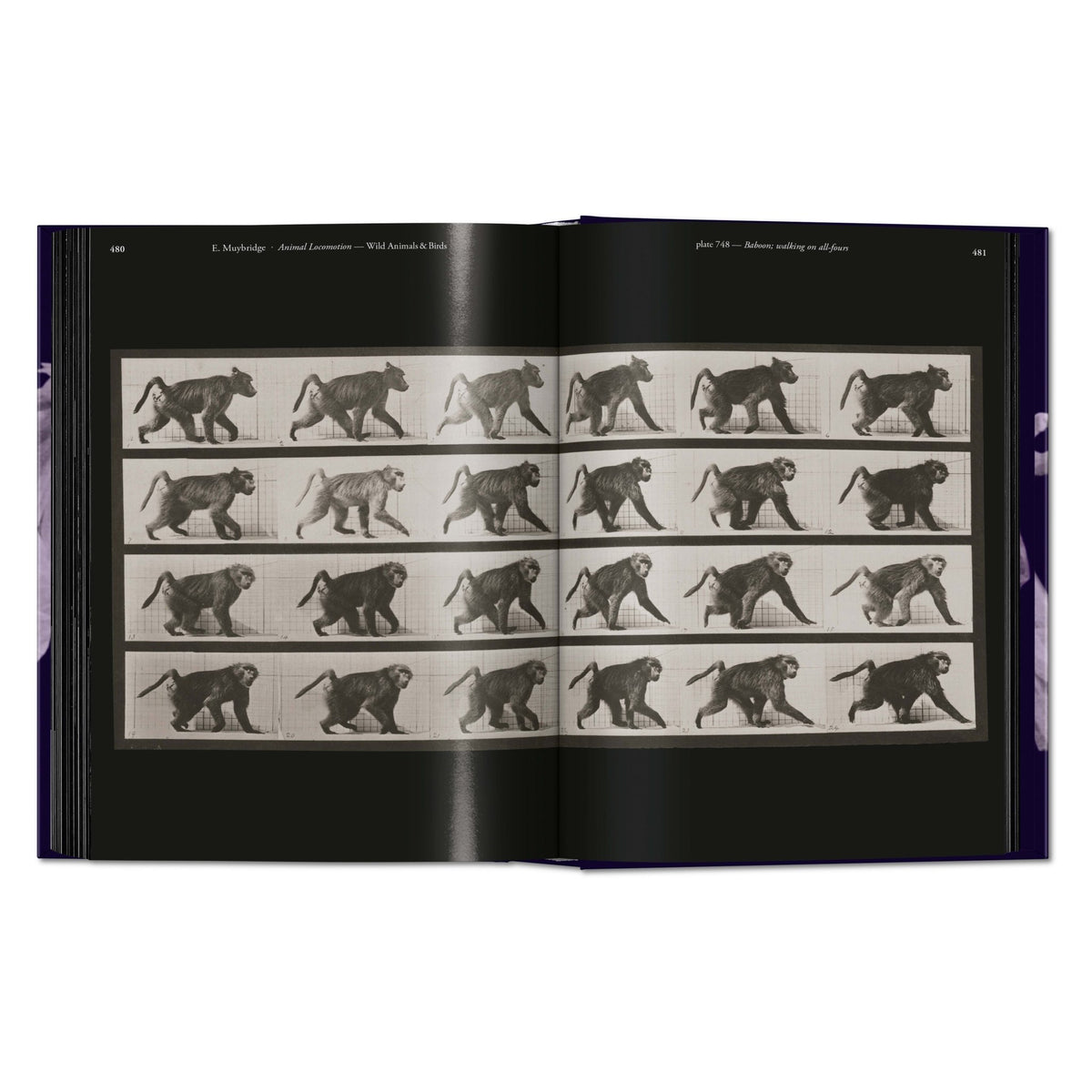
Muybridge's sequences are some of the most recognizable images in photographic history: a horse caught mid-stride, a figure mid-jump, a body turning through a grid of frames. Printed against dark grounds, they read like contact sheets from an experiment that ended up changing how we see. Each frame is a fact. Put together, they start to behave like film.
The plates pictured here include horse and rider studies, athletes and acrobats, figures in flowing fabric, and animal sequences with elephants and baboons. The grids are hypnotic on their own, but they are also practical. Animators, choreographers, illustrators and directors have long turned to Muybridge as reference, because his frames show what the eye misses at full speed.
In Signals, we keep books that explain where our tools came from. This one sits close to the starting line of the moving image.
About Eadweard Muybridge
Eadweard Muybridge (1830–1904) was an English photographer, born Edward James Muggeridge in Kingston upon Thames. He emigrated to the United States at about 20, worked as a bookseller in New York and San Francisco, and made his name photographing the American West, including Yosemite Valley in 1867. He later adopted Eadweard, the Old English form of Edward.
His breakthrough came for Leland Stanford, the former governor of California and a racehorse owner. In June 1878, at Stanford's Palo Alto farm, a battery of 12 cameras triggered by tripwires captured a running horse in sequence and showed that it had all four hooves off the ground. Published as The Horse in Motion, the images made Eadweard Muybridge photography famous worldwide. His zoopraxiscope projected motion pictures from glass discs, and from 1883 to 1886 at the University of Pennsylvania he produced over 100,000 images, published in 1887 as Animal Locomotion, 781 plates in 11 volumes. Animals in Motion (1899) and The Human Figure in Motion (1901) followed.
His life had a dark chapter: in 1874 he shot and killed his wife's lover, Harry Larkyns, and in 1875 a jury acquitted him on the grounds of justifiable homicide. He retired to England in 1894 and died in Kingston upon Thames on May 8, 1904. Animators, illustrators and filmmakers still use Muybridge's sequences as reference, and they sit at the root of the motion picture.
Why Muybridge still matters
Before slow motion, before the GIF, Muybridge showed that time could be sliced into frames and studied. His sequential photographs are widely seen as an important step toward cinema, and they still shape how we think about timing, rhythm and the body in motion. For anyone who cuts footage, animates characters or directs movement, his grids are a lesson in how motion is built, one frame after another.
Who this book is for
For filmmakers, editors, animators, photographers, motion designers, illustrators and choreographers who want to understand movement at the level of the single frame. Art directors and photo editors will find a masterclass in sequencing and the grid. For the RIOT and vandal_ crowd, it is the book for anyone who has ever scrubbed through footage one frame at a time and found the shot hiding in there.
Product details
-
Title: Muybridge. The Human and Animal Locomotion Photographs.
-
Photographer: Eadweard Muybridge (1830–1904)
-
Publisher: TASCHEN
-
Edition: 45th Ed.
-
Languages: German, French, English
-
Contents: Detailed chronology and many plates, with images from Animal Locomotion and The Attitudes of Animals in Motion
FAQ
What does this Muybridge book include?
A look at his life and work with a detailed chronology and many plates, featuring in particular images from Animal Locomotion and from his handmade, extremely rare first album, The Attitudes of Animals in Motion.
Is it useful as a reference for animation and film?
Yes. Muybridge's sequential studies of human and animal movement remain a classic reference for animators, filmmakers and illustrators studying timing and motion.
What languages is the text in?
This 45th Ed. is trilingual, with text in German, French and English.