


Peter Paul Rubens Book: Baroque Painting, Mythology & Art History
Peter Paul Rubens Book: Baroque Painting, Mythology & Art History
Couldn't load pickup availability
Peter Paul Rubens did not paint quietly. He painted with motion, flesh, spectacle, and force.
This TASCHEN volume is a compact but vivid introduction to one of the great architects of Baroque painting, an artist whose work fused drama, sensuality, intellect, and technical brilliance into some of the most powerful images of the early modern world. TASCHEN describes Sir Peter Paul Rubens as a key figure in the art world and a flag bearer for Baroque color, motion, and sensuality, while noting the extraordinary range of his output across altarpieces, portraits, landscapes, historical scenes, and mythological subjects.
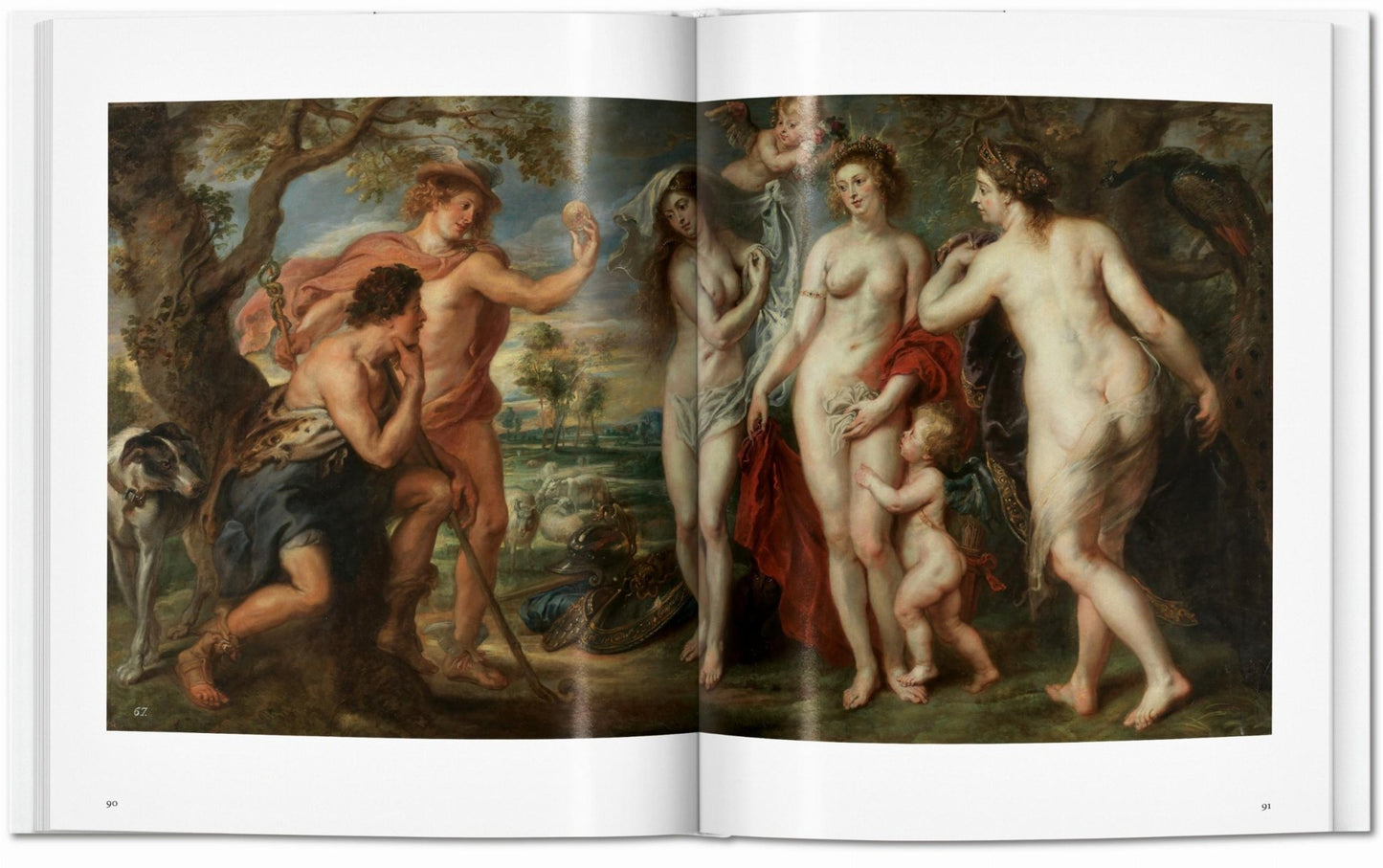
There are more than 1,000 catalogued works attributed to Rubens, and that sheer scale is part of what still makes him feel enormous. But volume alone is not the story. Rubens mattered because he could make painting feel alive. Bodies twist. Fabrics surge. Horses rear. Light cuts across skin, armor, clouds, and muscle. Whether he was staging a violent battle, a devotional scene, or an erotic mythological tableau, Rubens knew how to turn narrative into movement and movement into image. TASCHEN’s overview emphasizes both his prolific output and his ability to create scenes that remain visually compelling and legible.
 What makes Peter Paul Rubens essential is not only his scale, but his confidence. His paintings are lush without becoming soft, theatrical without losing intelligence, and sensual without losing structure. This book traces those strengths through his most important works, examining his influences, innovations, and long visual afterlife. TASCHEN places Rubens in the wider history of art through artists such as Van Dyck and Velázquez, showing how far his reach extended beyond his own century.
Rubens was also more than a painter. TASCHEN highlights his roles as a classical scholar, diplomat, and knight, which makes this book especially interesting for readers who want to understand not just the images, but the scale of the man behind them. He was an artist operating at the intersection of culture, power, religion, politics, and performance, which is part of why his paintings still carry so much charge.

For artists, designers, filmmakers, students, collectors, and anyone building a stronger visual library, this is a sharp entry point into Rubens’s world. It works as both an accessible introduction and a compact reference object, a book that opens a door into Baroque art, mythological painting, religious storytelling, portraiture, and the history of visual excess done right.
In Signals, we see books like this as more than books. They are source material. Cultural voltage in printed form. Proof that scale, beauty, and drama still matter.
About Peter Paul Rubens
Sir Peter Paul Rubens (1577–1640) was a Flemish painter and diplomat, born in Siegen in present-day Germany to parents who had fled Antwerp. The family returned to Antwerp when he was about 12, and the city remained his base for life. He is regarded as the most influential artist of the Flemish Baroque, and his full-figured women gave English the adjective Rubenesque.
Signature Peter Paul Rubens paintings include The Raising of the Cross (1610) and The Descent from the Cross (1611–1614) for Antwerp's Cathedral of Our Lady, the Marie de' Medici cycle installed in the Luxembourg Palace in Paris in 1625 and now in the Louvre, the ceiling paintings for Inigo Jones's Banqueting House in London, and The Three Graces in the Prado. His style runs on movement, color and sensuality. He ran a large workshop from the house and studio he designed himself, now the Rubenshuis museum, where assistants including the young Anthony van Dyck helped meet demand from across Europe.
Rubens was a working diplomat too: Philip IV of Spain raised him to the nobility in 1624, and Charles I of England knighted him in 1630. He died in Antwerp on May 30, 1640, of heart failure linked to chronic gout. For image-makers, Rubens is the original master of staging, with big casts, choreographed bodies and a studio system that looks a lot like a modern production company.
Why Peter Paul Rubens still matters
Peter Paul Rubens remains one of the defining painters in European art because he mastered the relationship between storytelling and sensation. His work gave Baroque painting its sweep, momentum, and fleshly intensity, while influencing generations of artists after him. TASCHEN’s Rubens is designed as an essential introduction to that legacy, bringing together the artist’s most important works in a concise format that helps readers understand both his innovations and his enduring art historical impact.

Who this book is for
For painters, designers, art students, collectors, and anyone interested in Peter Paul Rubens, Baroque painting, mythology, religious art, and art history.
Product details
- Title: Rubens
- Artist: Peter Paul Rubens
- Publisher: TASCHEN
- Series: Basic Art Series
- Author: Gilles Néret
- Language: English
- Format: Hardcover
- Trim Size: 8.3 x 10.2 in.
- Weight: 1.23 lb
- Pages: 96
- ISBN: 978-3-8365-4514-3
FAQ
What is this Peter Paul Rubens book about?
This TASCHEN book introduces Peter Paul Rubens through his major works, influences, innovations, and long-term impact on art history, with coverage of portraits, landscapes, historical paintings, mythological scenes, and his famous nudes.
Is this a good Rubens book for beginners?
Yes. TASCHEN presents it as an essential introduction, which makes it a strong starting point for readers who want a concise but meaningful overview of Rubens and Baroque art.
Who wrote this edition?
The book is written by Gilles Néret, an art historian, journalist, and museum correspondent whose TASCHEN titles also include books on Dalí and Matisse.
What format is this edition?
This edition is listed as a hardcover English-language book with 96 pages.



What is vandal_?
A creative marketplace for the misfit class. We curate tools, gear, assets, fonts, streetwear and digital weapons for people rewriting the rules. No fluff. No permission. All signal.
What kind of stuff do you sell?
Display fonts. Glitch textures. Gradient payloads. Tools that hit. Hoodies, Zines, essays, assets, shirts that don’t ask. Everything is made by or curated by creators who choose to live outside the algorithm.
Is vandal_ royalty-free?
Yup. Buy it once. Use it in your work, client or personal. Don’t resell it or pretend you made it. That's the only rule.
How can I join the marketplace?
If you make dope, useful, weird, disruptive creative stuff, we want to see it. Drop us a line. We’re building this together.
Why does vandal_ feel different?
Because it is. This isn’t just commerce. It’s community, rebellion, and real creativity, all wrapped in downloadable, readable and wearable form.
-

Anime and Cyberpunk Soundtracks Worth Owning on...
Ghost in the Shell: SAC, Cowboy Bebop, Cyberpunk: Edgerunners and Future Sound of Night City. What each sounds like, what is in the box, and where to start.
Anime and Cyberpunk Soundtracks Worth Owning on...
Ghost in the Shell: SAC, Cowboy Bebop, Cyberpunk: Edgerunners and Future Sound of Night City. What each sounds like, what is in the box, and where to start.
-

What Is a Circuit-Bent Camera?
A camera taught to make mistakes. Where circuit bending comes from, what it looks like straight out of camera, and which bent camera to pick.
What Is a Circuit-Bent Camera?
A camera taught to make mistakes. Where circuit bending comes from, what it looks like straight out of camera, and which bent camera to pick.
-

Variable ND Filters Explained: What They Do and...
Why daylight video needs ND, how much you need, how a variable ND works, and which filter fits which camera and lens.
Variable ND Filters Explained: What They Do and...
Why daylight video needs ND, how much you need, how a variable ND works, and which filter fits which camera and lens.


